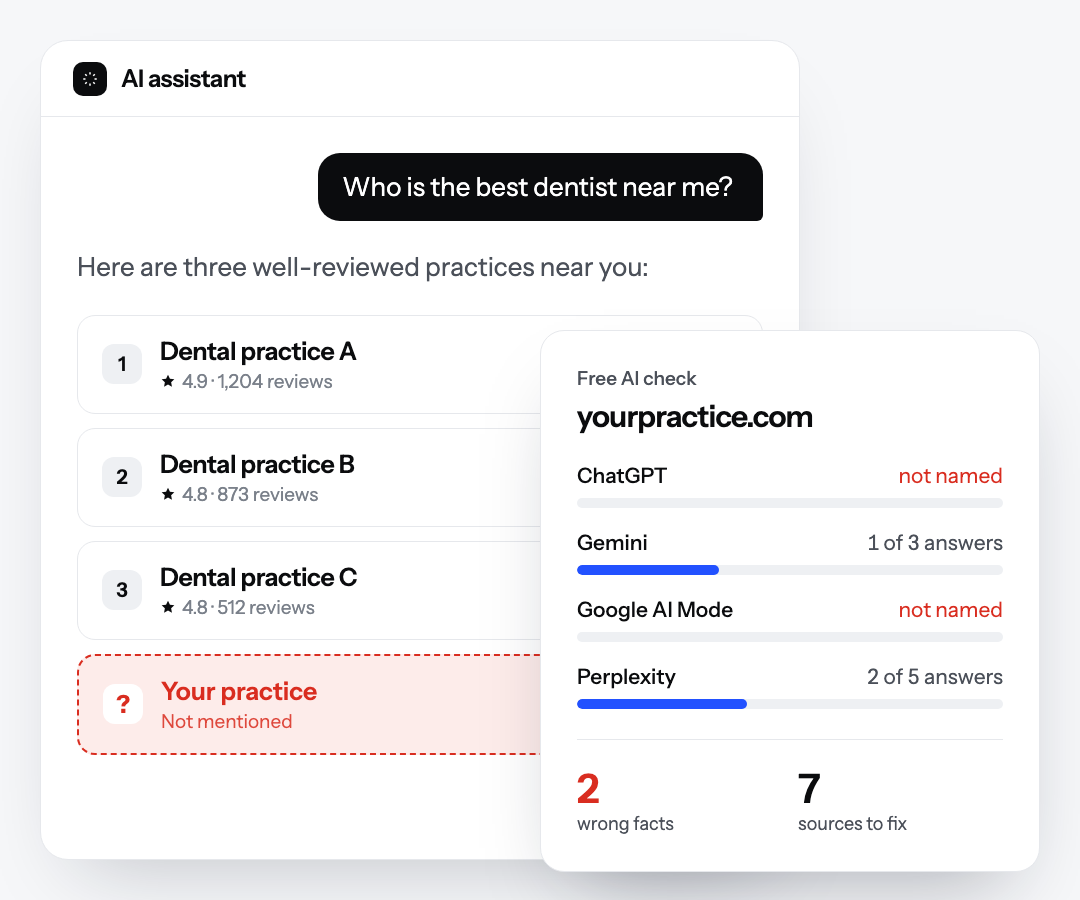
What happens when a patient asks AI for a dentist
On 3 October 2026 we asked the question a new patient would ask, “Can you recommend a good dentist in Austin, TX?”, five times in ChatGPT, three times in Gemini and once in Google’s AI Mode, and compared it with Google’s own map results.
- ChatGPT named 14 different practices across five runs. One practice came first in all five; only a handful appeared most of the time. Three runs would have missed several names that five runs found.
- Gemini was consistent with itself but not with ChatGPT. It named nearly the same six practices every time, a different list from ChatGPT’s.
- Google AI Mode named a third set. Across all four sources, 18 different practices appeared for one question in one city on one day.
Question:“Can you recommend a good dentist in Austin, TX?”
| Practice | ChatGPT5 runs | Gemini3 runs | Google AI Mode1 run | Google Maps (top results)1 run |
|---|---|---|---|---|
| Practice A | ||||
| Practice B | ||||
| Practice D | ||||
| Practice C | ||||
| Practice H | ||||
| Practice I | ||||
| Practice E | ||||
| Practice F | ||||
| Practice G | ||||
| Practice J | ||||
| Practice K | ||||
| Practice L | ||||
| Practice M | ||||
| Practice N | ||||
| Practice O | ||||
| Practice P | ||||
| Practice Q | ||||
| Practice R |
The lesson for a practice owner: a single screenshot of ChatGPT “recommending” you, or not, proves very little. What matters is how often you are named across many runs, on each engine your patients use.
Where the answer comes from
ChatGPT shows dentists as business cards with a star rating and a review count. Those numbers come from somewhere you control:
- In the US, often from Yelp. About half of the ChatGPT business cards we captured in the US carried Yelp’s logo and showed Yelp’s numbers. In Denver, every one of ten dental cards we checked showed the Yelp rating: an average of 3.9 stars and 807 reviews in total, against 4.75 stars and 5,422 reviews on Google for the same ten practices.
- In the UK and EU, from Google. Every card we checked there matched the Google Business Profile exactly.
- Gemini leans on Google Maps. Across our checks it named most of the businesses in Google’s local results, often in the same order.
The pages AI cited for dental questions in our checks were the ADA’s Find-a-Dentist directory, Zocdoc, Birdeye review pages, Healthgrades and WebMD, plus practice websites for English-language questions. Across all local businesses, websites make up 42% of AI citations and Google Business Profiles 28.6% (BrightLocal, Sep 2026).
What AI knows about dental practices, and what it doesn’t
Courtyard tested what four AI engines know about 120 dental practices across 50 US and Canadian markets (State of AI Visibility, July 2026; Courtyard sells AI visibility software):
| What AI was asked about | Score | What to publish |
|---|---|---|
| Which services the practice offers | 0.83 of 1 | Keep your service list identical on site, Google profile and directories |
| What treatments cost | 0.04 of 1 | “From” prices, how pricing works, financing |
| Depth of knowledge overall | 51 of 100 | One page per treatment, with the provider who performs it |
| Answers hedged (“contact the practice”) | 62% | Insurance accepted, emergency hours, languages spoken |
In practice: AI can say you do implants. It can’t say what implants cost at your practice, whether you take Delta Dental, or whether you see emergencies on Saturdays. When we asked engines about specific practices, we found old addresses still circulating from outdated directory listings, and a second Google profile splitting one practice’s reviews in two.
Local SEO for dentists: the profile that feeds Google and AI
Your Google Business Profile is the single most important source for both the map pack and AI answers. Get these right first:
- One profile per location. Find and merge duplicates, they split your reviews and confuse AI about your address.
- The right primary category (Dentist, Cosmetic dentist, Pediatric dentist, Orthodontist…) and every service you offer.
- Hours that are true, including holidays and emergency availability.
- Real photos of your team and rooms, not stock.
- The same name, address and phone on Bing Places, Apple Business Connect, Yelp and every dental directory.
Service and price pages AI can quote
Create one page per procedure patients ask about: implants, All-on-4, clear aligners, crowns, whitening, emergency visits. Each page should answer, in plain words near the top:
| Block | What it says |
|---|---|
| Who it’s for | Typical patient situation, in one or two sentences |
| What happens | Steps, number of visits, recovery |
| Price | A “from” range or how the price is calculated, with the date it was last checked |
| Paying | Financing options, insurance notes, in-network plans |
| Who does it | The dentist who performs it, with credentials |
Keep it compliant: ranges, not promises of outcomes.
Insurance: answer the question patients ask
“Dentist near me that takes [plan]” is one of the most common patient questions, and one AI usually can’t answer. Publish a page listing the plans you accept and how out-of-network works, and keep it in sync with your Google profile and Zocdoc.
Reviews: volume, replies and HIPAA
75% of patients won’t book with a doctor rated below 4.0 stars, and 66% say replies to reviews matter (rater8, 2026). And 97% of people who use AI sometimes check its recommendation against real reviews (BrightLocal, 2026).
- Ask every patient after the visit, no filtering out unhappy ones, no incentives.
- Reply to reviews without confirming that the reviewer is your patient or mentioning treatment details.
- In the US, claim your Yelp page and keep it correct: it is often the rating ChatGPT shows. Yelp’s rules forbid asking customers for Yelp reviews specifically, so focus on accuracy and replies there.
Directories that matter for dentists
| Directory | Country | Seen in AI answers in our checks |
|---|---|---|
| Google Business Profile | All | Yes, basis of most cards |
| Yelp | US | Yes, about half of US ChatGPT cards |
| ADA Find-a-Dentist | US | Yes |
| Zocdoc, Healthgrades, WebMD, Birdeye | US | Yes |
| Doctify, CQC register | UK | Yes |
| Doctolib, Jameda | DE, FR | Yes |
| Doctoralia, MioDottore, ZnanyLekarz | ES, IT, PL | Yes |
Patients who search in other languages
In Vienna we asked ChatGPT for a dentist in German and in English. The two answers shared only 3 of 21 practices. Practices that state the languages they speak, on the website and the Google profile, were the ones named for “English-speaking dentist”. In the US the same applies to Spanish-speaking patients.
What we do for dental practices
- Audit: we ask ChatGPT, Gemini and AI Mode your patients’ questions several times, check what they say about your practice, and compare you with the practices they name instead.
- Fix the sources: Google profile, Yelp, Bing, Apple and the dental directories AI cites in your country, one consistent set of facts.
- Publish what AI can’t find: treatment, price, insurance and team pages.
- Measure the same way every month, so you see change in “named in k of n answers”, not vague reports.
Deep audits start at $1,200 and monthly maintenance at $790. See pricing · How we measure
A note on dental marketing rules
We never buy, filter or write reviews, never promise treatment outcomes, and keep review replies free of patient information. If your state board restricts terms like “specialist”, your pages will follow those rules.
FAQ
How do I get my dental practice recommended by ChatGPT?
Start with the sources ChatGPT’s business cards are built from: one complete Google Business Profile per location, a claimed and correct Yelp page (in the US), consistent listings on ADA Find-a-Dentist, Zocdoc and Healthgrades, a steady flow of reviews, and service pages that state prices and insurance. Then measure over several runs, one answer is not a verdict.
Is AI SEO for dentists different from dental SEO?
Most of the work is the same: profile, reviews, directories, clear service pages. The difference is what you publish, prices, insurance, providers, languages, emergency hours, and how you measure: the same patient questions asked repeatedly in ChatGPT, Gemini and Google AI Mode instead of one keyword ranking.
Does ChatGPT use Google reviews or Yelp reviews for dentists?
Both, depending on the country. In the UK and EU, the ratings on ChatGPT’s business cards matched the Google profile exactly in our checks. In the US, about half of the cards carried Yelp’s logo and Yelp’s numbers, in Denver, all ten dental cards we checked showed the Yelp rating, often well below the Google one.
Why does ChatGPT recommend different dentists every time?
Answers vary from run to run. BrightLocal measured only 20–33% overlap when the same local question is asked again. In our Austin test, ChatGPT named 14 different practices across five runs; only a few appeared every time. Track how often you are named across runs, not a single screenshot.
Should a dental practice publish prices on its website?
If you can, publish “from” ranges and explain how pricing works, including financing and insurance. AI engines almost never know dental prices (a price-understanding score of 0.04 out of 1 in Courtyard’s 2026 study), so a clear, current range gives them something accurate to quote instead of a guess.