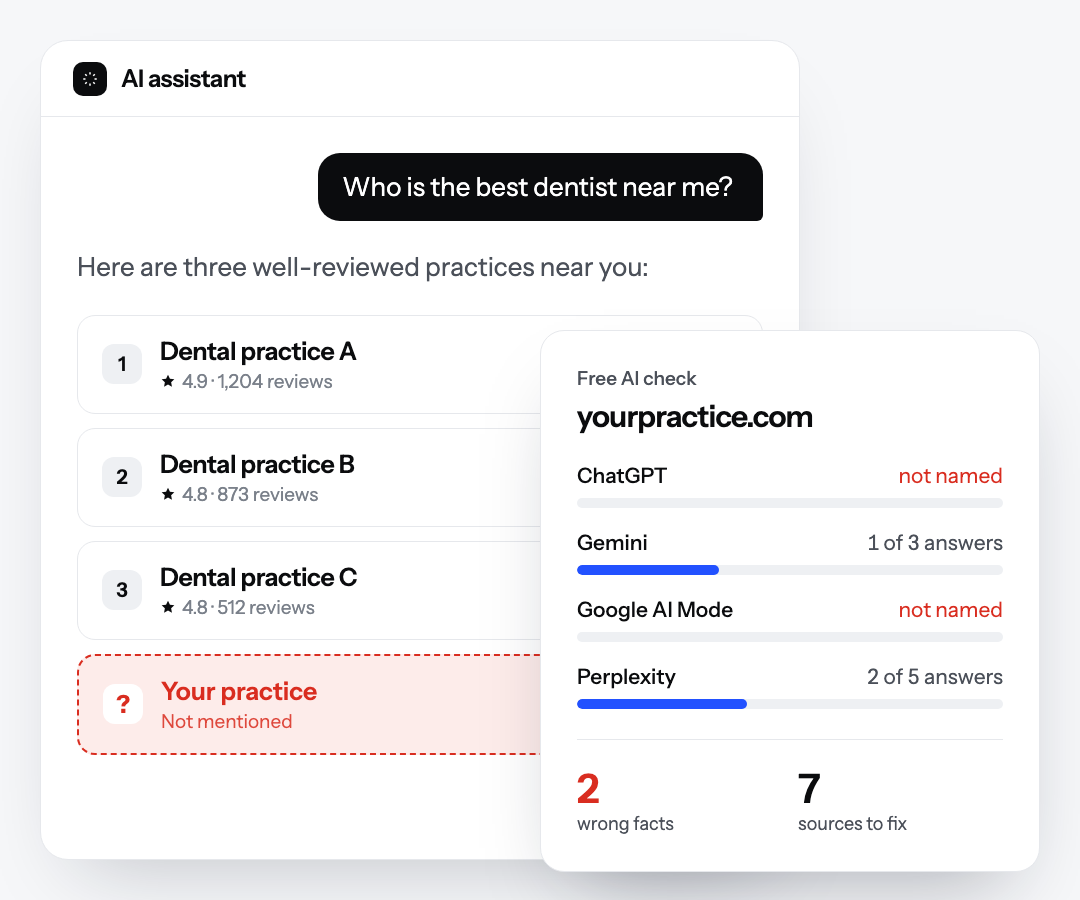
GEO in one paragraph
Search engines return a list of links. Generative engines, AI assistants and AI search modes, return a written answer: a few businesses, a few sentences about each, sometimes a rating and a link. GEO is everything you do so that this answer includes you and gets your facts right: name, address, hours, services, prices, credentials. The “generative” part means the engine writes the answer on the spot, from sources it searches at that moment. So GEO is mostly about those sources.
The engines that matter most for local businesses today:
| Engine | Why it matters |
|---|---|
| ChatGPT | 31% of US consumers used it for local recommendations in the past 12 months (BrightLocal, 2026) |
| Google AI Mode | 23% in the same survey; Google says AI Mode “surpassed one billion monthly users” (Google I/O, May 2026) |
| Gemini | The Gemini app passed one billion monthly users (TechCrunch, Aug 2026) |
| Perplexity, Copilot, Siri | Smaller for local questions today; Siri’s new AI launched in beta on iOS 27 in English, not in the EU at launch (Apple, Sep 2026) |
How does GEO work? How an AI assistant builds a local answer
An AI assistant does not look up a fixed ranking. For a question like “a good dentist in Austin”, it runs a web search, reads what comes back, and writes an answer. What we saw in real answers on 3 October 2026 (our check, small samples):
- It searches for reviews, not for your website. ChatGPT’s background search was typically one query in the style of “dentist Austin reviews 2026”. In some industries it added trust words: “licensed FMCSA” for movers, “bar association” for lawyers, CQC ratings for UK dentists.
- It reads directories and rating sites. ChatGPT cited about 1.8 websites per answer, mostly directories and review platforms rather than business websites. Across 200,085 US local prompts, BrightLocal found websites make up 42% of AI citations, Google Business Profiles 28.6% and Yelp 9.5% (BrightLocal, Sep 2026).
- It shows business cards built from profiles. In the UK and the EU, every ChatGPT business card we checked carried exactly the rating and review count of the business’s Google profile. In the US, about half the cards (159 of 341) carried Yelp’s logo and Yelp’s numbers instead.
- It names a handful of businesses. ChatGPT names about 4 businesses per local answer on average (BrightLocal), far fewer than a page of map results.
Gemini works differently: it answered almost entirely out of Google Maps, linking to Maps listings in 60 of the 87 answers we collected. Google AI Mode builds answers from Google’s place cards and business websites. That is why the same question gets different answers in different engines.
GEO for a local business: profiles, directories, reviews
Most writing about GEO is aimed at software companies and publishers, where the goal is to get an article cited. For a business with a street address the inputs are more concrete, and mostly outside the website:
- Your Google Business Profile, the data behind cards in ChatGPT (outside the US), Gemini and AI Mode.
- Yelp, in the US. Yelp announced a licence for its reviews, ratings, photos and business data in ChatGPT on 23 July 2026 (Yahoo Finance).
- National and industry directories. Checkatrade and MyBuilder for UK trades, Checkatrade appeared in 78 of 80 AI answers in one small UK study (Murray Digital, Aug 2026); Avvo and Justia for US lawyers; Doctolib in France; Herold in Austria, all seen in our checks.
- Your own pages, when they state facts plainly: services, prices, areas, languages, credentials. In real estate, 98.1% of the sources ChatGPT cited were the agent’s own Google profile or website (OmniEclipse, 2026; vendor study, small sample).
The most common problem we found was not that AI ignores a business, but that it repeats contradictions. Of 21 businesses we checked by name in detail, 12 had a website, Google profile or booking system that disagreed with each other, on hours, phone numbers or addresses, and the engines picked one version.
Why GEO is measured differently from SEO
There is no stable position to track. Ask the same question again and the list changes: AI engines repeat only 20–33% of the businesses they named (BrightLocal, Sep 2026). In our check, 119 of the 297 businesses ChatGPT named across 29 questions appeared in only one of five identical runs.
Engines also disagree with each other. Across three rounds, the lists from ChatGPT and Gemini overlapped by only 0.17–0.22 (Jaccard similarity); for one Denver plumbing question they had no business in common:
Question:“Can you recommend a good plumber in Denver?”
2026-10-03
ChatGPT5 answers
- Plumber B
- Plumber C
- Plumber A
- Plumber D
- Plumber E
- Plumber F
- Plumber G
- Plumber H
Gemini3 answers
- Plumber I
- Plumber K
- Plumber J
- Plumber L
- Plumber M
0businesses on both lists
And a good map ranking does not carry over automatically: businesses tracked by BrightLocal appeared in 66% of Google Maps results but in only 33% of ChatGPT answers and 32% of AI Mode answers. So GEO measurement asks the same questions several times on each engine and reports a fraction, “named in 3 of 5 answers”, not a rank. Our method.
Find out how often AI names you, and who it names instead
What GEO work consists of
For a local business, a GEO project is a list of concrete, checkable jobs:
| Job | Done when |
|---|---|
| Let AI crawlers read your site | Search crawlers such as OAI-SearchBot get the real page, not a block or an empty shell |
| Complete and correct Google profile (plus Bing and Apple) | Verified, right category, true hours, no duplicates |
| Directories AI searches in your country and industry | Same name, address and phone everywhere |
| Pages that state facts | Services, prices or price ranges, areas, languages in plain HTML |
| Reviews | A steady request process, no buying, filtering or incentives |
| Mentions elsewhere | Local press, associations, video, brand mentions correlate with AI visibility more than links do (Ahrefs, 2025; correlation, not proof) |
| Measurement | Same questions, same engines, several runs, before and after |
That is the outline of our GEO services, with deliverables, acceptance criteria and prices.
What GEO is not
- Not an llms.txt file. About 10% of sites have one, and SE Ranking found no link between having it and being cited (SE Ranking, Nov 2025). Google says llms.txt, special “AI schema” and content chunking aren’t needed (Google Search Central, 2026).
- Not FAQ markup for rich results. Google stopped showing FAQ rich results on 7 May 2026 (Google changelog).
- Not mass AI-written content. Of 220+ publicized AI-content “success stories”, 54% later lost at least 30% of their peak traffic (Lily Ray, May 2026; a self-selected sample).
- Not a “position in ChatGPT”. Anyone selling a guaranteed spot is selling something that doesn’t exist.
GEO, SEO and AEO
GEO, AEO (answer engine optimization) and “AI SEO” are three labels for the same goal; the differences are mostly marketing. Google’s position is that optimizing for generative AI search “is still SEO”. We explain the overlap and the real differences in two short comparisons: GEO vs SEO and AEO vs GEO. For the practical side of ChatGPT specifically, see how to get recommended by ChatGPT.
How to start with GEO
- Ask the question your customers ask, “a good [your service] in [your city]”, in ChatGPT, Gemini and Google AI Mode. Ask each one three to five times in fresh chats and write down who is named.
- Ask about yourself by name. Check the address, hours, phone, prices and services each engine gives against your own website and Google profile.
- Fix the sources, not the answer. Correct your Google profile, the directories the engines cited, and your own pages, so all of them say the same thing.
- Measure again in 60–90 days with the same questions and the same number of runs.
Or let our free audit do steps 1 and 2 for you. Our full dataset is on the research page.
FAQ
What is GEO in SEO?
GEO (generative engine optimization) is the part of SEO aimed at AI-generated answers rather than lists of links: making ChatGPT, Gemini, Google AI Mode and Perplexity name your business and describe it correctly. Google itself says optimizing for generative AI search is still SEO, so the foundations are the same.
What is GEO in marketing?
It depends on who says it. In AI search, GEO means generative engine optimization. In advertising, “geo” often means geotargeting, showing ads to people in a location. They are unrelated. If an agency offers “GEO”, ask which one they mean.
Is GEO replacing SEO?
No. AI answers are built from the same web pages, profiles and reviews that search engines index. What changes is where the facts about you need to be, and how results are measured: repeated AI answers instead of one ranking.
How long does GEO take to work?
Nobody can promise a date, because AI answers change from run to run. Fixes to your own sources, Google profile, directory listings, service pages, can be done in weeks. We measure the same questions before the work and again after 60 and 90 days, and report what changed as “named in k of n answers”.
Does GEO work for small local businesses?
Local is where GEO is most concrete. For “who should I call in my city” questions, AI assistants rely on Google Business Profiles, review sites and national directories, all things a small business can claim and correct.
What does GEO SEO mean?
It is usually just another way of writing generative engine optimization. Some people use “geo SEO” for local SEO (geographic). Both meet in one place: for local questions, AI answers depend heavily on local SEO sources such as your Google profile.