Are AEO agency services worth the cost?
Some are, some aren’t. Paying for work that changes the facts AI reads about you is worth it. Paying extra for “AI-specific” tricks usually isn’t.
Owners asking this question tend to raise the same two objections, and both are fair:
- “It’s just SEO with a new name.” Mostly true. Crawlable pages, a complete Google profile and reviews are the base. What’s different is the target: a short answer that names three to five businesses, not a page of ten links.
- “Nobody can measure it.” Half true. AI answers change from run to run, asked again, engines repeat only 20–33% of the businesses they named (BrightLocal, Sep 2026). You can measure it, but only by asking the same questions several times on each engine and counting how often you are named.
For a local business, the questions are concrete: who is good near me, how much does it cost, do you take my insurance, are you open on Saturday, do you speak Spanish, are you licensed. AEO is making sure the engines have a correct, citable answer to each, and that you’re in it.
What you don’t need to pay for
You don’t need to pay for llms.txt files, special “AI schema”, FAQ markup for rich results, single-run “ChatGPT rankings” or reviews you didn’t earn. Here is the evidence, and what we do instead.
| What’s sold | Evidence | What we do instead |
|---|---|---|
| An llms.txt file “so AI can read you” | About 10% of ~300,000 domains have one; SE Ranking found no link between having it and being cited by AI. SE Ranking, Nov 2025 | Make sure AI crawlers can reach your pages |
| Special “AI schema” or content “chunking” | Google: optimizing for generative AI search “is optimizing for the search experience, and thus still SEO”; no llms.txt, chunking or special schema needed. Google Search Central, May 2026 | Valid, business markup that matches your Google profile |
| FAQ markup to win rich results | Google stopped showing FAQ rich results on 7 May 2026. Google Search Central changelog, May 2026 | Plain answers on the page, written for people |
| “Your position in ChatGPT” from single runs | Asked again, engines repeat only 20–33% of the businesses they named. In our check, half the businesses ChatGPT named appeared in one of five runs. BrightLocal, Sep 2026; our check, 3 Oct 2026 | Repeated runs per engine, reported as “named in k of n” |
| Bought, filtered or rewarded reviews | Fake and incentivized reviews are banned under the FTC’s 2024 rule in the US and the DMCC Act in the UK, and they’re what AI users check: 97% sometimes compare AI recommendations with real reviews. BrightLocal, 2026 | Ask every customer, reply to every review |
Those five items are on many AEO proposals. None of them is why an assistant names one dentist and not another. Our audit checks what matters, and nothing you don’t need.
Where your customers’ questions get answered
Customers ask several AI surfaces, and each answers differently. In the US, 31% of people used ChatGPT and 23% Google AI Mode for local recommendations in the past year (BrightLocal, 2026). Google says AI Mode has passed one billion monthly users (Google, May 2026), and the Gemini app has more than a billion too (TechCrunch, Aug 2026).
We asked the same local questions on four surfaces on 3 October 2026. Same question, four kinds of answer:
| Surface | Businesses named per answer | Business cards | Domains cited per answer | What it leans on |
|---|---|---|---|---|
| ChatGPT (app) | 4.7 | Business cards with rating and reviews in 38 of 40 runs | 1.8 | Searches “category city reviews year”; cites directories and rating sites more than business websites. US cards: about half from Yelp; UK/EU: from Google. |
| Gemini (app) | 3.9 | Links to Google Maps places | 1.3 | Answers out of Google Maps: maps.google.com links in 60 of 87 answers across our three rounds. |
| Google AI Mode | 2.9 | Place cards (“Name 4.9 (808)”) | 2.9 | Built from Google place data plus business websites. Made the most factual errors in our by-name checks. |
| Perplexity (API) | 3.0 | None | 7.8 | Cites the most sources, often sends people to portals (Zocdoc, Healthgrades, ZnanyLekarz). API, not the consumer app. |
Our check, 3 Oct 2026, first round: 8 local questions, 104 requests; averages per answer. Small sample. Perplexity measured through its API, not the consumer app.
Three things follow for a business owner:
- The lists differ. ChatGPT’s and Gemini’s lists for the same question overlapped by only 0.17–0.22 (Jaccard similarity) across our rounds. Being named in one says little about the others.
- AI Overviews are rarely the surface for local questions. They appeared on 3 of 29 “category + city” searches; Google showed its map results instead. AI Mode and Gemini are where Google’s AI answers local questions.
- Voice assistants are next. Apple’s new Siri, built on Apple models developed together with Google’s Gemini, entered beta on 14 September 2026, in English first, and not in the EU or China at launch (Apple, Sep 2026). Which sources it uses for local answers is not known yet.
The full dataset is on our research page.
Get the audit that checks what matters, and nothing you don’t need.
What our AEO work includes
Our AEO work is six concrete deliverables, built around the questions your customers ask:
- A question map: 20–40 real customer questions per service, price, insurance or payment, timing, area, language, credentials, in the words customers use.
- Answer pages and sections that state the fact in the first sentence (“Implants from $X, including the crown; financing available”), with the date it was last checked.
- Profile facts aligned: Google Business Profile, Bing Places, Apple Business Connect and the top directories for your country say the same thing as your website.
- A brand-question check: what each engine says about your business by name, with every wrong fact traced to its source and fixed there.
- A review-request process: ask every customer, no filtering, no incentives; reply to reviews.
- A re-check after 60 and 90 days on the same questions, engines and run counts, reported as “named in k of n”.
If you want the whole engagement, crawler access, directories, PR, monthly maintenance, that is our full GEO programme. For DIY, our guide on getting recommended by ChatGPT walks through the steps.
The brand question: what AI says about you
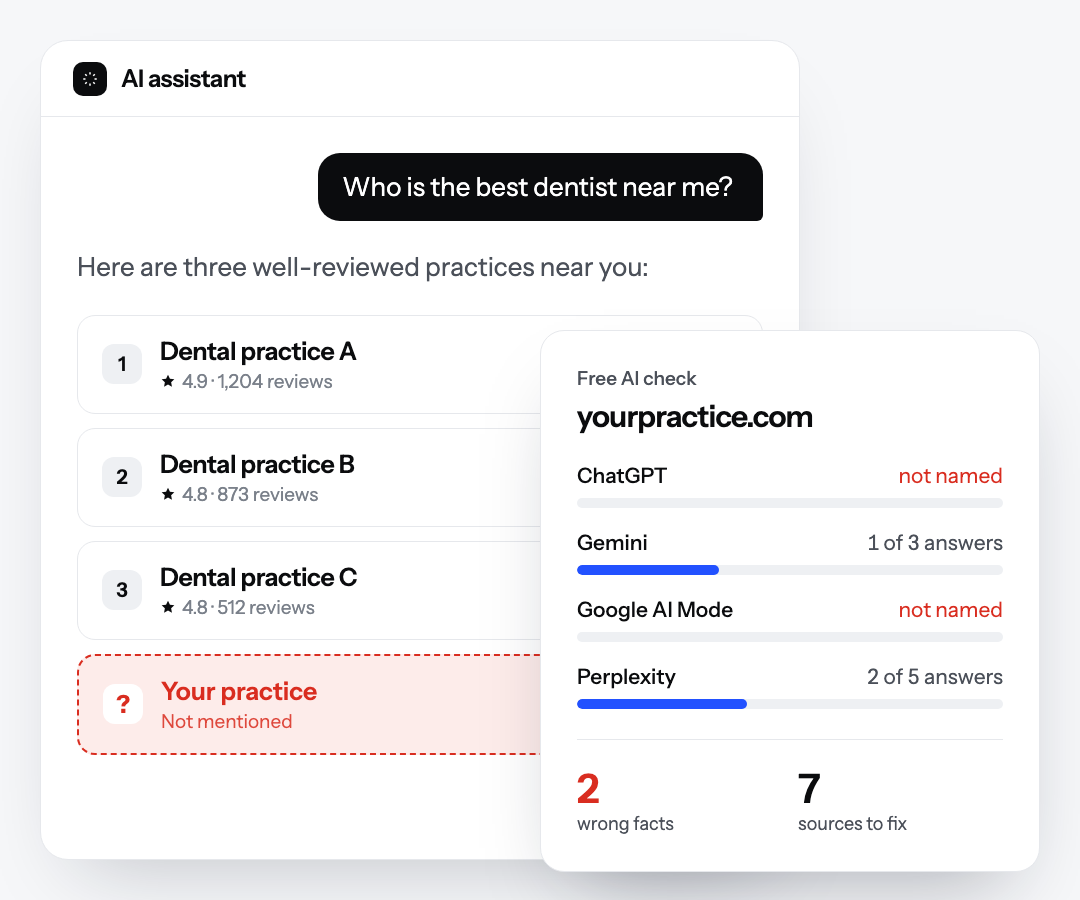
The cheapest, most useful AEO check is to ask each engine about your business by name, and compare the answer with your own website and Google profile. We did this for 21 businesses in 10 countries on 3 October 2026.
- 16 of 21 had at least one fact, hours, phone, address, price, that differed between engines or from the business’s own sources.
- In 12 of 21, the business’s own sources disagreed with each other: the website said one set of hours, the Google profile another, the booking system a third. Each engine picked one version.
- We counted 15 clear engine errors: 8 in Google AI Mode, 4 in Perplexity, 3 in ChatGPT, opening hours from an old listing, a phone number from a look-alike website, another practice’s prices presented as this one’s, dollars quoted for a UK roofer.
- The clean cases were businesses whose website and Google profile agreed. When the facts matched in both places, the engines repeated them correctly.
Why it matters: 97% of people who use AI for local recommendations sometimes check them against real reviews (BrightLocal, 2026). A wrong phone number or old price loses the customer at exactly that moment. The brand question is part of every audit we run, including the free one.
What AEO costs
AEO with us is either a one-off, check, plan, then a fixed implementation, or a monthly plan. Prices exclude VAT:
- Express+: $300–500 (€290–490), an extended check plus a 30-minute call.
- Deep audit: $1,200–1,900 (€890–1,490), credited 100% to implementation within 30 days.
- Foundation implementation: $3,000–4,500 (€2,400–3,200).
- Monitor: $149–249 a month; Maintain: $790–1,290 (€590–990) a month. Month to month, 30 days’ notice.
For context, US agencies quote $1,500–5,000 a month for small-business GEO and AEO retainers (WebFX, May 2026, an agency’s own figures). See full pricing · How we measure
FAQ
Is AEO different from SEO?
AEO is SEO work aimed at answers rather than lists of links. Google itself says optimizing for generative AI search “is still SEO”. The differences are the unit, questions and facts instead of keywords, and the measurement: repeated AI answers instead of rankings.
Do I need an AEO agency or an AEO consultant?
A consultant is enough if someone on your side can update your site and profiles. If nobody can, an agency does it. Our deep audit and plan work for both, and you can stop after the audit.
How do I optimize for Google AI Mode?
For local questions, AI Mode builds answers from Google place cards: your Google Business Profile data, reviews and website. Get those complete and consistent first. There is no separate AI Mode markup to add.
How do I show up in Gemini?
Gemini answered local questions out of Google Maps in our check, 60 of 87 answers linked to maps.google.com, and its lists closely followed Google’s map results. Your Google profile is the main lever.
Which AEO agencies are best for small businesses?
Use criteria instead of a ranking: experience with local businesses and Google profiles, a measurement method with repeated runs, published prices, and no upsell of llms.txt or “AI schema”. We don’t rank ourselves.
How much does AEO cost?
With us, an Express+ check with a call is $300–500 (€290–490), a deep audit $1,200–1,900 (€890–1,490), and monthly plans start at $149. See the pricing page for the full ladder.