The short answer
Many owners’ first question about ChatGPT is whether they can pay to be in it. Searches for “chatgpt ads” reached about 14,800 a month in the US, up roughly 2,120% on a year earlier; “advertise on chatgpt” about 1,000. In Germany “chatgpt ads” is at about 1,300 and in France about 1,000 (Google Ads estimates via DataForSEO, August 2026, from our keyword research).
Here is what we can say with confidence:
- Ads on ChatGPT exist. OpenAI documents a crawler for checking ad landing pages.
- An ad is not a recommendation. ChatGPT’s answer to “a good plumber in Denver” is built from search results and business cards. We could not confirm any link between buying ads and appearing in that answer.
- We saw no ads in local answers. In 197 ChatGPT answers to local questions we collected on 3 October 2026, none contained an ad unit.
- The details a local business needs, countries, formats, prices, minimum spend, local targeting, we could not confirm. More on that below.
What is publicly known about ChatGPT ads
We only list what we could read in a primary source ourselves, on 3 October 2026.
| Fact | Source |
|---|---|
| OpenAI operates OAI-AdsBot, which “is used to validate the safety of web pages submitted as ads on ChatGPT”. OpenAI may visit those landing pages to check policy compliance and relevance. | OpenAI crawler documentation |
| Data collected by OAI-AdsBot “is not used to train generative AI foundation models”. | Same page |
| Organic search visibility uses a different bot: OAI-SearchBot “is used to surface websites in search results in ChatGPT’s search features”. | Same page |
| Yelp licensed its reviews, ratings, photos and business data to OpenAI for ChatGPT, announced 23 July 2026, non-exclusive. A “Request a Quote” feature inside ChatGPT was announced as “set to follow”. | Yahoo Finance, MediaPost, Jul 2026 |
Two practical consequences. If you ever run an ad, the page you send people to will be checked by a bot, so it must load for crawlers and not be blocked by your firewall. And if your robots.txt or firewall blocks OAI-SearchBot, your site can’t be shown in ChatGPT’s search features at all, ad or no ad.
What we could not confirm
Not confirmed by us as of 3 October 2026. OpenAI’s advertiser pages (ads.openai.com) and announcement pages returned errors to our checker, so we could not read them. We therefore make no claims about:
- which countries and which ChatGPT plans show ads, one market report says a US open beta started in May 2026; reported, not confirmed by us;
- ad formats and where in the conversation they appear;
- pricing, bidding model and minimum spend;
- whether local or radius targeting exists for small businesses;
- whether running ads has any effect on which businesses ChatGPT names in its answers.
Read OpenAI’s own advertiser pages directly before you set a budget, and ask any agency offering ChatGPT ads to show you the source for each of these points.
What we saw in 197 local answers
On 3 October 2026 we asked ChatGPT local questions, “a good dentist in Austin”, “a plumber in Manchester”, “a divorce lawyer in Barcelona” and so on, across 10 countries, each category question five times, plus questions about specific businesses by name, and stored every answer. Of 197 ChatGPT answers, none contained an ad unit. What they did contain, almost every time, were organic business cards: in the first round, 38 of 40 answers showed cards with a star rating and review count.
Where those cards came from:
- UK and EU: the Google profile. In seven countries, 0 of 307 cards carried a third-party logo, and all 12 businesses we compared matched their Google profile exactly.
- US: Google or Yelp. 159 of 341 US cards carried Yelp’s logo and Yelp’s numbers.
Limits: small samples on one day, collected through a scraper of the ChatGPT interface. A logged-in user on a particular plan, in a particular country, may see ads we didn’t. Our answers show what the organic part looks like, not that ads never appear. Details in our research.
Ads vs. organic: side by side
For a local business, the two routes differ less in where they show and more in what you own afterwards.
| ChatGPT ad | Organic recommendation | |
|---|---|---|
| What you pay for | A paid placement, on terms set by OpenAI (not confirmed by us for local businesses) | Work on your own sources: profiles, listings, reviews, pages, no media spend |
| Where you appear | Wherever OpenAI places ads (placement and labelling not confirmed by us) | Inside the answer, as a named business or card |
| What it depends on | Budget and OpenAI’s ad rules | What ChatGPT finds: Google profile, Yelp (US), review sites, directories, consistent facts |
| Other engines | ChatGPT only | The same sources feed Gemini, Google AI Mode and Google Maps |
| When you stop paying | The placement stops, you were renting it | Profiles, reviews and pages stay, you own them |
| How to measure | Ad reporting from the platform (details unconfirmed) | Same questions, repeated runs: “named in k of n” |
| Trust | A paid placement; people still check reviews before they call | People still check reviews before they call |
Owners on small-business forums describe paid lead channels the same way: “renting visibility I’ll never own, if I stop paying, I disappear.” Organic sources are the opposite: once your Google profile, listings and pages are right, they keep working across engines.
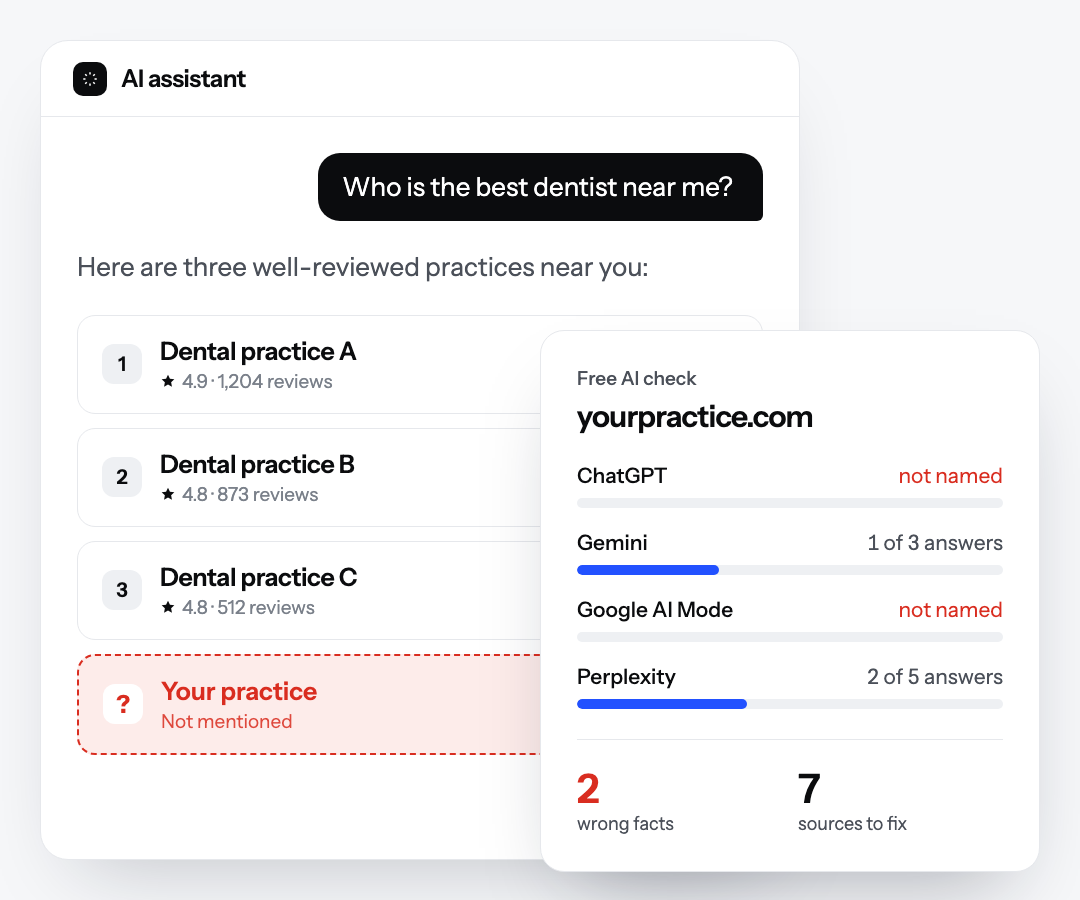
Find out if ChatGPT already names you, before you spend on ads.
When an ad might make sense
An ad can be worth testing once its terms are clear to you and your organic basics are in place:
- A new location or service that has no reviews yet and can’t be recommended on merit for a while.
- A time-limited offer, a seasonal check-up, a launch price, where speed matters more than permanence.
- A market where you are already named often and want extra reach, with the budget to measure it properly.
It makes little sense when your Google profile is incomplete, your Yelp page (US) shows a low rating you’ve never looked at, or your website contradicts your listings. Then the ad sends paying traffic to the same weak sources.
Why you need the organic sources anyway
Even a perfect ad ends at your business’s public footprint. 97% of people who use AI to find local businesses sometimes check its recommendation against real reviews (BrightLocal, 2026). They land on your Google profile, your Yelp page, your website. If those disagree with each other, the click is wasted.
That happens more than owners expect. When we checked 21 businesses by name, 12 had a website, Google profile or booking system that contradicted each other, different hours, two phone numbers, three addresses. AI engines picked one version, and so would a customer coming from an ad.
The organic work is also the cheaper experiment. Claiming and correcting your profiles costs time, not media budget, and the same fixes reach Gemini and Google AI Mode too. In US local AI answers, websites make up 42% of citations, Google Business Profiles 28.63% and Yelp 9.53% (BrightLocal, Sep 2026). The step-by-step plan is in how to get ChatGPT to recommend your business.
Be careful with “ChatGPT position” offers
Don’t pay anyone who promises a “#1 position in ChatGPT”, paid or organic. There is no fixed position: asked the same local question twice, AI engines repeat only 20–33% of the businesses they named (BrightLocal, Sep 2026). In our first round, 44 of 90 businesses ChatGPT named appeared in only one of five runs. Why ChatGPT has no fixed rank explains how to measure instead.
Questions to ask anyone selling ChatGPT visibility, paid or not:
- Which primary source confirms the ad product, country and price you’re quoting?
- How many runs per question do you measure, and on which engines?
- Will every account be in my name, and can I leave month to month?
We don’t sell ChatGPT ads. Our ChatGPT optimization service works on the organic side, Google profile, Yelp in the US, directories, pages and reviews, with every account in your name and results reported as “named in k of n”.
FAQ
Can you advertise your business on ChatGPT?
OpenAI runs ads on ChatGPT: its own crawler documentation describes OAI-AdsBot, which checks “web pages submitted as ads on ChatGPT”. Which countries, plans, formats and prices apply to a local business we could not confirm. Check OpenAI’s own advertiser pages before you plan a budget.
Can I pay ChatGPT to recommend my business?
Paying buys an ad placement, not a place in ChatGPT’s own answer. The businesses ChatGPT names organically come from what it finds: your Google profile, Yelp in the US, review sites and directories. We could not confirm whether ads have any effect on those answers, so don’t assume they do.
Did you see ads in ChatGPT answers about local businesses?
Not in our check. In 197 ChatGPT answers to local questions we collected on 3 October 2026 in the US and Europe, none contained an ad unit. We collected them through a scraper of the ChatGPT interface; what a logged-in user on a given plan sees may differ.
Are ChatGPT ads available outside the US?
We could not confirm it. Searches for “ChatGPT ads” are growing fast in Germany and France too, but we found no primary source we could read that lists the countries. Treat any agency claim about availability in your country as something to verify with OpenAI directly.
Is it better to run ChatGPT ads or optimize for organic recommendations?
For most local businesses, fix the organic sources first: they cost no media budget, they keep working when you stop paying, and an ad sends people to the same profiles and reviews anyway. An ad may make sense later for a time-limited offer or a new location, once you know the format and cost.
Do you sell ChatGPT ads?
No. We work on organic recommendations: the profiles, listings, reviews and pages AI engines read. Every account stays in your name. If you decide to run ads, we can tell you whether the page you send people to answers what ChatGPT and customers look for.