The short answer
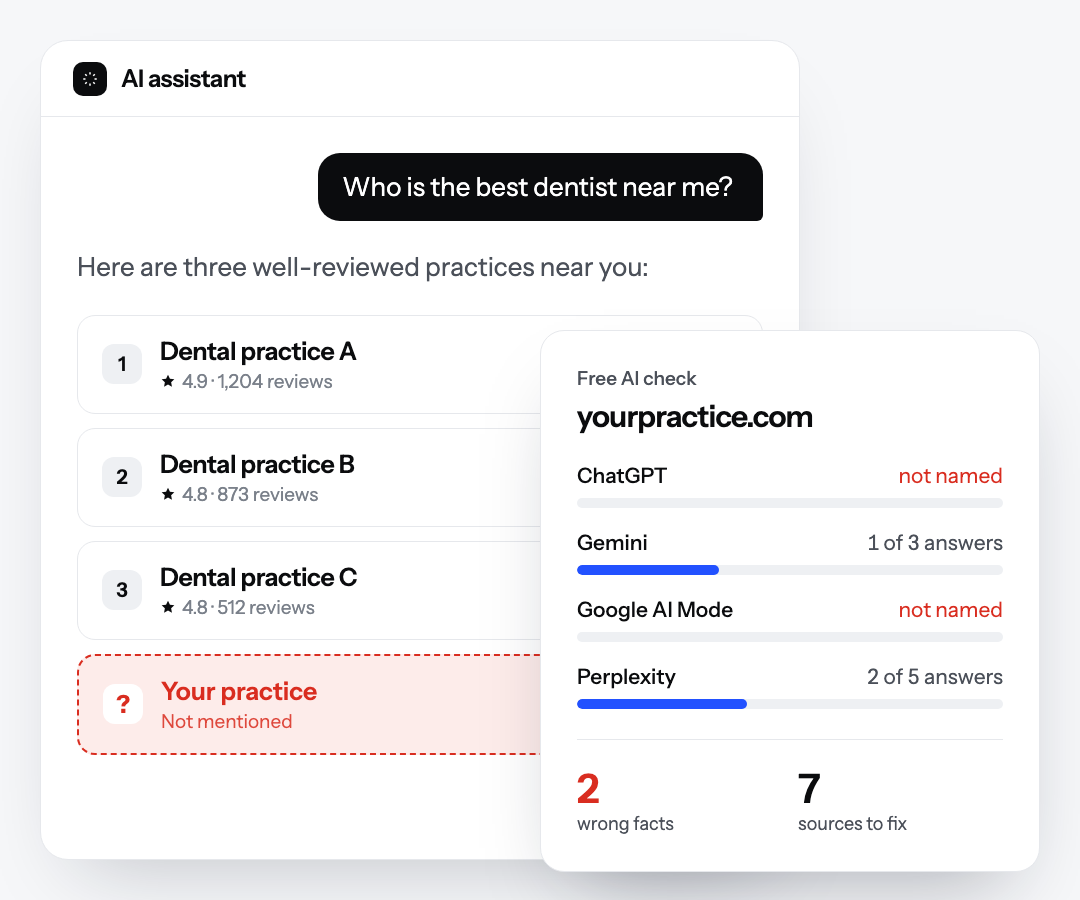
SEO gets your pages ranked in a list of links. GEO (generative engine optimization) gets your business named, and described correctly, in an answer that ChatGPT, Gemini or Google AI Mode writes. The second depends on the first: AI engines search the web and read what ranks, what is cited and what is listed. But being ranked is no longer the whole job, because AI answers draw on more sources than your website and change every time they are asked.
GEO vs SEO side by side
| SEO | GEO | |
|---|---|---|
| Result people see | A ranked list of links and a map | A written answer naming a few businesses |
| Unit of success | Position of a page for a keyword | Being named, with correct facts, for a question |
| Main inputs | Your pages, links, technical health, Google profile (for local) | The same, plus review sites, directories and mentions the engine searches |
| Stability | Rankings move slowly | Answers change between runs and between engines |
| How to measure | Rank tracking, Search Console | Same questions asked several times per engine: “named in k of n” |
| Special files or markup | Valid structured data helps understanding | No special “AI schema” or llms.txt needed, per Google |
What stays the same
Most of the foundation. Crawlable pages, clear content written for people, a correct Google Business Profile, real reviews and mentions all still count. Google lists no special requirements for its AI features: llms.txt, content “chunking” and special schema are not needed (Google, 2026). Independent data agrees on llms.txt: across about 300,000 domains, SE Ranking found no link between having the file and being cited (SE Ranking, Nov 2025).
Clicks still matter too. Seer Interactive found that brands cited in a Google AI Overview got about 120% more clicks per impression than brands that weren’t (Seer Interactive, Apr 2026; 53 brands, 5.47 million queries).
What is different
1. Ranking well no longer guarantees being named
Only 37.9% of the pages cited in Google AI Overviews came from the top 10 organic results, and 31% came from beyond the top 100 (Ahrefs, Mar 2026; the method changed versus Ahrefs’ 2025 study). For local businesses, BrightLocal found tracked businesses in 66% of Google Maps results but in only 33% of ChatGPT answers and 32% of AI Mode answers (BrightLocal, Sep 2026). In our own check across seven European countries, only 19 of the 37 businesses shown in Google’s local map results appeared anywhere in ChatGPT’s five answers to the same question.
2. Sources outside your website weigh more
Websites make up 42% of local AI citations, Google Business Profiles 28.6% and Yelp 9.5% (BrightLocal). Different engines cite different pages: 91% of cited URLs appeared in only one of ChatGPT, Perplexity and AI Overviews (Growth Memo, May 2026; 3.7 million citations). Mentions also seem to count more than links: brand mentions on YouTube and the web correlated more strongly with AI visibility than backlink measures in an Ahrefs study of 75,000 brands (Ahrefs, 2025; correlation, not proof).
3. Results have to be measured as a frequency
AI engines asked the same local question twice repeat only 20–33% of the businesses they named (BrightLocal). In our check on 3 October 2026, 119 of the 297 businesses ChatGPT named appeared in only one of five identical runs. A rank tracker shows one number; a GEO report shows how often you were named out of how many answers, per engine. How we measure.
4. Facts matter as much as visibility
AI repeats whatever your sources say, including the contradictions. Of the 21 businesses we checked by name in detail, 12 had a website, Google profile or booking system that disagreed with each other on hours, phones or addresses, and engines picked one version. Classic SEO rarely audits this. See the data.
Check what AI engines say about you, and whether it’s right
For a local business: where GEO and local SEO meet
For a dentist, plumber or law firm, GEO and local SEO overlap almost completely. Your Google Business Profile feeds Google’s map results, Gemini (which linked to Google Maps in most answers we collected) and, outside the US, the business cards in ChatGPT. In the US, about half of ChatGPT’s cards in our sample showed Yelp’s rating instead of Google’s. The difference is in the extras: the review sites and national directories each engine searches, pages that state prices and services in plain words, and measurement across engines.
What to do about it
- If your SEO is solid, extend it: audit what AI says about you, fix contradictions between your website, Google profile and directories, and add repeated AI-answer measurement.
- If your SEO is weak, fix the basics first. GEO built on a blocked site or a duplicate Google profile doesn’t hold.
- Either way, don’t buy llms.txt files, “AI schema” or promised positions in ChatGPT.
If you want it done for you, our GEO agency service lists every phase, deliverable and price. For the definition and the basics, read what is GEO; for the labels agencies use, AEO vs GEO.
FAQ
Is GEO better than SEO?
Neither is better; GEO depends on SEO. AI answers are built from pages, profiles and reviews that search engines already index. GEO adds the sources AI leans on for local answers and a different way to measure results.
Will GEO replace SEO?
Not on current evidence. Google says optimizing for generative AI search is still SEO, and people still click through: when a brand is cited in a Google AI Overview it gets about 120% more clicks per impression than when it is not (Seer Interactive, 2026).
What is the difference between AI SEO and traditional SEO?
Traditional SEO tracks rankings of your pages. AI SEO tracks whether AI answers name you and describe you correctly, which also depends on your Google profile, directories and reviews, and has to be measured over several runs because answers change.
Do I need a separate GEO agency if I have an SEO agency?
Only if your SEO agency doesn’t cover the AI layer: profile and directory accuracy, review processes and repeated AI-answer measurement. If it already does, keep it. Ask how they measure AI answers before you decide.
Does ranking first on Google mean AI will recommend me?
Not automatically. Only 37.9% of Google AI Overview citations came from the top 10 organic results in an Ahrefs study, and businesses in 66% of Google Maps results appeared in only 33% of ChatGPT answers in BrightLocal’s data.